
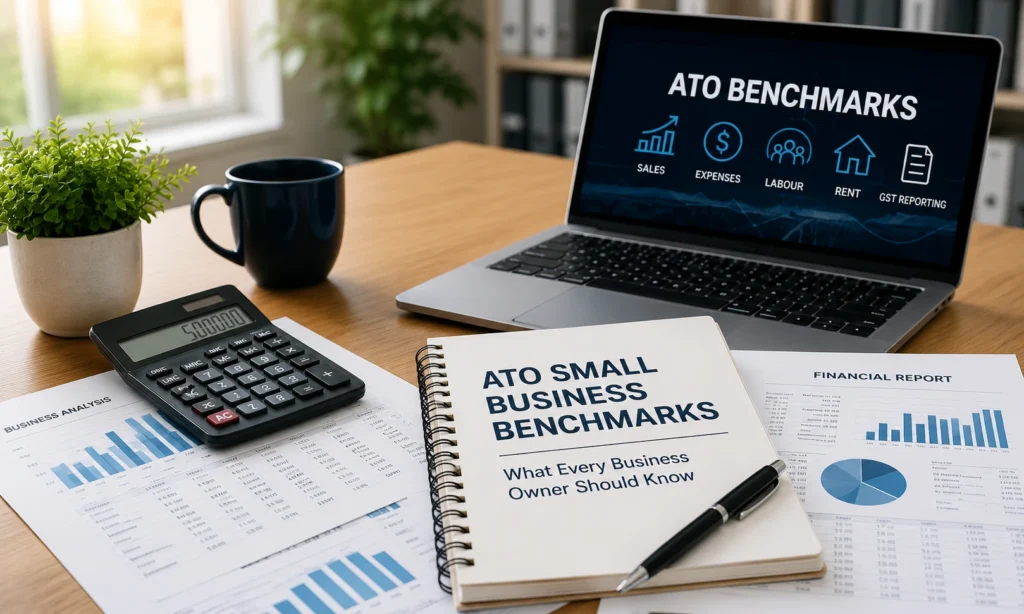
Many small business owners believe the Australian Taxation Office only reviews a business when someone reports it or when there is an obvious mistake in a tax return.
That is not always the case.
The ATO uses data and industry benchmarks to compare your business with other businesses operating in the same industry. These benchmarks can help the ATO identify businesses that may require a closer look.
The ATO currently publishes small business benchmarks for around 100 industries. These benchmarks are based on information reported in business tax returns and activity statements. They are used as both a business performance tool and a tax-compliance risk indicator.
This means your business may be compared with similar businesses before an ATO officer has even spoken to you.
What are ATO small business benchmarks?
ATO small business benchmarks are financial ranges showing how businesses in a particular industry normally report their income and expenses.
Depending on your industry, the ATO may compare ratios such as:
- cost of sales compared with annual turnover, excluding labour
- total expenses compared with annual turnover
- labour expenses compared with annual turnover
- rent expenses compared with annual turnover
- motor vehicle expenses compared with annual turnover
- non-capital purchases compared with total sales
- GST-free sales compared with total sales.
The ATO calculates a benchmark ratio by dividing the relevant expense or amount by turnover and multiplying the result by 100.
For example:
Cost of sales ÷ Annual turnover × 100
If your cost of sales is $180,000 and your annual turnover is $500,000, your cost-of-sales ratio would be:
$180,000 ÷ $500,000 × 100 = 36%
That percentage can then be compared with the ATO benchmark for your industry and turnover range.
A takeaway food business example
Takeaway food businesses are a good example of how ATO benchmarking works.
The current ATO benchmark separates takeaway food businesses into different annual turnover ranges. Across those turnover categories, the published cost-of-sales benchmark is approximately 34% to 43%.
The exact acceptable range depends on the business’s annual turnover. For example, the current turnover categories include:
- $65,000 to $200,000
- $200,001 to $600,000
- more than $600,000.
The cost-of-sales ranges vary between these categories.
Imagine a takeaway business with annual turnover of $500,000 and cost of sales of $250,000.
Its cost-of-sales ratio would be:
$250,000 ÷ $500,000 × 100 = 50%
A ratio of 50% would be above the published benchmark for that turnover category.
This does not automatically mean the business has done anything wrong. There may be genuine reasons for the difference, such as:
- unusually high ingredient prices
- food wastage
- incorrect stock records
- changes in the type of food being sold
- large discounts or promotions
- incorrect classification of wages as cost of sales
- missing or understated sales
- personal purchases incorrectly recorded as business expenses.
However, when the figures are significantly outside the industry range and the business does not have proper records or a reasonable explanation, the ATO may consider the business to be higher risk.
The ATO confirms that benchmarks are used together with other risk indicators to identify businesses that may not be reporting all their income correctly.
The ATO also compares GST-free sales
Expense ratios are not the only figures the ATO reviews.
For industries that make a mixture of taxable and GST-free sales, the ATO may compare the amount reported as GST-free sales with the total sales reported on the business activity statement.
This is particularly important for businesses such as:
- takeaway food businesses
- cafés and restaurants
- grocery and convenience stores
- bakeries
- health-related businesses
- other businesses selling a mixture of taxable and GST-free products.
Incorrect GST coding can significantly change the percentage of GST-free sales reported on your BAS.
For example, a business may accidentally code taxable takeaway food as GST-free. Another business may record bank transfers, owner contributions or loan proceeds as GST-free sales when they are not sales at all.
These mistakes can create an unusual GST-free sales ratio and may make the business appear different from similar businesses in the same industry. The ATO specifically includes GST-free sales to total sales as an activity statement benchmark.
Being outside the benchmark does not automatically mean an audit
A benchmark is not a tax law, and every business is different.
Your business may have a genuine commercial reason for being outside the normal range. You may operate from an expensive location, use premium ingredients, have unusually high delivery costs or employ more staff to provide a better level of service.
The problem arises when:
- the figures are incorrect
- sales have not been fully reported
- expenses have been entered into the wrong categories
- private expenses have been claimed through the business
- wages are incorrectly included in cost of sales
- GST codes have been applied incorrectly
- the business cannot support its figures with proper records.
The ATO states that being outside a benchmark does not necessarily mean a business has done something wrong. However, unusual ratios may indicate errors, underreported income or areas requiring further examination.
Small accounting mistakes can create unnecessary risk
In many cases, the business has not intentionally done anything wrong.
The issue may simply be poor bookkeeping or an incorrect tax return presentation.
For example, entering wages into cost of sales instead of salary and wages can increase the cost-of-sales percentage. Using the wrong business industry code can result in your business being compared with the wrong industry. Incorrectly reporting multiple business activities can also distort the benchmark calculation.
Even when the business has reported the correct overall profit, incorrect classifications may create an unnecessary ATO risk indicator.
This is why it is important to review your benchmark position before lodging your annual tax return—not after receiving an ATO letter.
How Rick & Mon Business Consultants can help
Ricky Dheri and the team at Rick & Mon Business Consultants understand how ATO small business benchmarks work and how accounting classifications affect your reported ratios.
We have helped hundreds of small businesses review their financial records, correct bookkeeping errors and reduce unnecessary stress caused by avoidable reporting mistakes.
Our team can assist you with:
- reviewing your business against the correct ATO industry benchmark
- checking cost of sales, wages and other expense classifications
- reviewing GST-free and taxable sales coding
- reconciling BAS sales with annual tax return income
- identifying unusual expense ratios before lodgement
- maintaining proper supporting records
- preparing explanations where genuine commercial circumstances place the business outside the benchmark
- responding to ATO enquiries and reviews.
Our objective is not to artificially change your figures to fit a benchmark. Your tax return must always reflect the true financial position of your business.
Our role is to make sure your records are accurate, your expenses are classified correctly and your business does not attract unnecessary attention because of preventable accounting mistakes.
Review your figures before the ATO does
Do not wait until an ATO review or audit letter arrives.
A benchmark review can help identify accounting errors, GST coding problems, missing income and unusual expenses before your tax return is lodged.
If your business operates in takeaway food, hospitality, retail, construction, transport, professional services or another benchmarked industry, speak with the team at Rick & Mon Business Consultants.
We support small businesses across Melbourne and Australia with tax compliance, bookkeeping, BAS preparation, financial reporting and practical business advice.
Contact Rick & Mon Business Consultants today to arrange a review of your business figures and ATO benchmark position.
This article provides general information only and should not be treated as personal taxation advice. ATO benchmark ranges may be updated, and the appropriate range depends on your industry, turnover and individual business circumstances.